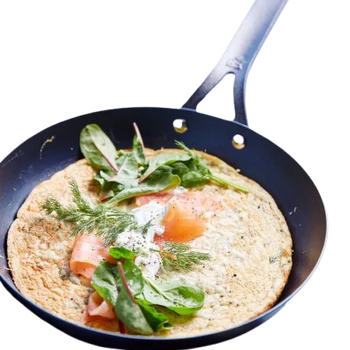
A good frying pan is an essential pan in every kitchen. It is the perfect pan for preparing various types of dishes, from fried eggs and pancakes to steak and vegetables. Read all about frying pans at the Cookinglife cookware store. You can also buy induction, gas, or ceramic frying pans from top brands here. We deliver lightning-fast from our own stock to your home.
What to look for when purchasing frying pans?
But what makes a frying pan good? There are several factors to consider when choosing a frying pan, such as the material, size, shape, suitability for a heat source (gas, induction, or ceramic), and quality. Moreover, there are many different types of frying pans available, each with its own specific characteristics, advantages, and disadvantages.
What exactly is a frying pan?
A frying pan is characterized by its flat bottom and low edges. It is a versatile pan that can be used for frying various types of food, such as eggs, pancakes, meat, fish, and vegetables.
Frying pans come in various sizes, materials, and shapes, and can be used on different types of heat sources, including gas, electric, and induction. Some frying pans are equipped with a non-stick coating, which makes frying food easier and can reduce the use of oil or butter.
What is a PFAS-free frying pan?
A PFAS-free frying pan is a frying pan that is free of PFAS substances. PFAS stands for poly- and perfluoroalkyl substances, a group of chemical substances that are frequently used in the production of non-stick coatings. However, these substances are harmful to humans and the environment and are therefore increasingly being banned from products.
A PFAS-free frying pan has a different type of non-stick coating that is free of these harmful substances, instead of a non-stick coating based on PFAS. This can, for example, be a ceramic-based non-stick coating, as is the case with Greenpan frying pans.
PFAS-free frying pans are therefore a healthier alternative to traditional frying pans with a non-stick coating based on PFAS. It is important to note, however, that not all non-stick coatings are based on PFAS and that not all frying pans with a non-stick coating are free of these substances. At Cookinglife, you will only find pans that are PFAS-free.
What is the difference between a frying pan and a sauté pan?
Although a frying pan and a sauté pan have many similarities, there are some important differences between the two pans.
A frying pan has a flat bottom and low edges, while a sauté pan has higher edges and sometimes a lid. This makes a sauté pan more suitable for preparing sauces, stews, and other dishes where higher edges are needed to scoop up ingredients and to prevent sauce or liquid from splashing out of the pan.
Another difference is that a sauté pan often has a non-stick coating and is sometimes oven-safe, whereas a frying pan does not always have this. As a result, a sauté pan is more suitable for preparing dishes that need to be cooked in the oven, while a frying pan is more suitable for frying food on the stovetop.
Finally, a sauté pan is often larger than a frying pan and is therefore more suitable for preparing larger portions. However, a frying pan is more convenient for frying smaller portions and for frying food that needs to be turned quickly, such as eggs or pancakes.
How do you recognize a frying pan suitable for induction?
A frying pan suitable for induction always has a magnetizable bottom, in other words, a bottom made of materials that react to a magnetic field. These magnetizable materials ensure that the pan can be heated by the induction hob, which in turn creates a magnetic field. To check if a frying pan is suitable for induction, you can view our product descriptions. It is always stated there whether a frying pan is suitable for induction.
What is a good frying pan?
What constitutes a good frying pan for you naturally varies greatly from person to person. That depends, of course, on which heat source you cook with. But in addition, you naturally have a choice between a heavier frying pan—think of a cast iron pan—or simply a light frying pan. The best frying pan is therefore different for each person. You also have a choice of a healthy frying pan, for example, a frying pan without PFAS or Teflon. The best frying pan for you depends on what appeals to you most.
What size frying pan do you need?
The size of frying pan you need depends on the heat source you cook on. For example, if you cook on gas, the diameter of the pan is less important; however, it is important that when using a small frying pan, you do not choose a burner where the flame is larger than the pan. But with an induction hob, for example, it is important that you do not use a frying pan that is too large. The pan should only protrude a maximum of 1 cm on both sides. If it is larger than this, the pan will not heat up properly. Therefore, there is a wide choice of different diameters of frying pans, for example 20, 24, 28, 30 or 32 cm.
What different non-stick coatings are there for the frying pan?
There are different types of non-stick coatings used for frying pans. Some of the most common are:
- Ceramic non-stick coating: This layer is made of ceramic material that is applied to the pan. It is a durable and environmentally friendly option that is free of PFAS and PFOA.
- Enameled non-stick coating: This layer is made of an enameled material that is applied to the pan. It is a durable and scratch-resistant option that is also dishwasher safe.
- Without non-stick coating: Some frying pans do not have a non-stick coating and rely on the natural properties of the material to prevent sticking, such as with cast iron frying pans.
- Standard non-stick coating: This is the traditional non-stick coating found on most frying pans. It is made of a Teflon-like material and can wear off or be damaged over time if metal utensils are used on it.
What should you look for when buying a frying pan?
Are you looking for a new frying pan, but aren't sure what to look for to make the right choice? Don't worry. In the overview below, we have listed some tips to help you choose the best frying pan.
-
Heat source: not every frying pan is universally usable. So check carefully whether the intended pan is compatible with the heat source you use for cooking.
-
Capacity: pay attention to the diameter of the pan; does the frying pan fit well on the stovetop? Additionally, it is important to know how many people you usually cook for. The larger the group, the larger the frying pan needs to be.
Material: do you choose stainless steel, copper, cast iron, or ceramic? Each type of material has its own advantages. For example, a copper frying pan conducts heat very well, and a cast iron pan has a long lifespan. Familiarize yourself with the various pros and cons before making a choice.
Handles: Does the frying pan feature cool-touch handles? Is there a second handle to easily lift a heavy pan? The way the handles are applied says something about the comfort with which you cook.
Lid: Does the pan come with a lid, or do you have to buy one separately? Is the lid made of glass or metal? Glass lids offer the possibility to view the contents.
Weight: How heavy is the pan? If you cannot lift heavy objects, it is important to pay attention to the weight; for instance, cast iron frying pans can be quite heavy. Stainless steel pans are generally much lighter.
Design: Do you often prepare dishes where you tend to spill easily? For example, dishes involving sauces. Then choose a snack pan. This is essentially a frying pan with a higher rim. As a result, you are less likely to spill and your countertop stays clean.
Non-stick coating: do you want a frying pan with or without a non-stick coating? If you choose a non-stick coating, which one do you choose? Read all about the pros and cons of the different options here.