The first question with cast iron is who does the work: you, or the pan itself, because it is already seasoned or has an enamel or ceramic layer. On the shop floor, we often saw issues with cast iron, especially with people who did not expect that work. The range is small, from entry-level models to the mid-range, and for each type, it then comes down to size and weight.
Do you need to season a cast iron frying pan yourself?
Self-seasoning only applies to untreated pans; for the other types here, that has already been done or is not necessary. You cannot always tell the type by the name, as both untreated and already seasoned pans have "without non-stick coating" in the title.
An untreated pan, such as the Blackwell Skillet, needs to be seasoned by you before you use it for the first time. In doing so, you build up a layer with oil that helps your food stick less, and that produces a lot of smoke. After that, you dry it on the fire after each wash, as anything that remains wet will rust.
The Beka Stark is pre-treated: already seasoned, so ready to use immediately. The same drying on the fire is necessary, as underneath that seasoned layer is bare cast iron.
With the enamelled Keij Kamado Skillet and the Beka Mandala with ceramic non-stick coating, you do not need to do anything beforehand. The enamel layer of the Keij is already on it, and in the Mandala, you cook directly on the layer. You should wash the Keij by hand, as the product page recommends. For the Mandala, use wooden or plastic utensils, as a damaged layer means a new pan.
Also the Combekk Frying Pan Skillet Classic Cast Iron Holly Green ø 26 cm is directly ready for use. Combekk makes it from recycled cast iron with a double layer of enamel, and it can go in the oven, on the barbecue, and on the kamado up to 260 °C. At 2.42 kg, it is heavier than the Keij, but its short handle fits more easily in the oven, according to the product page. According to Combekk, it should not go in the dishwasher.
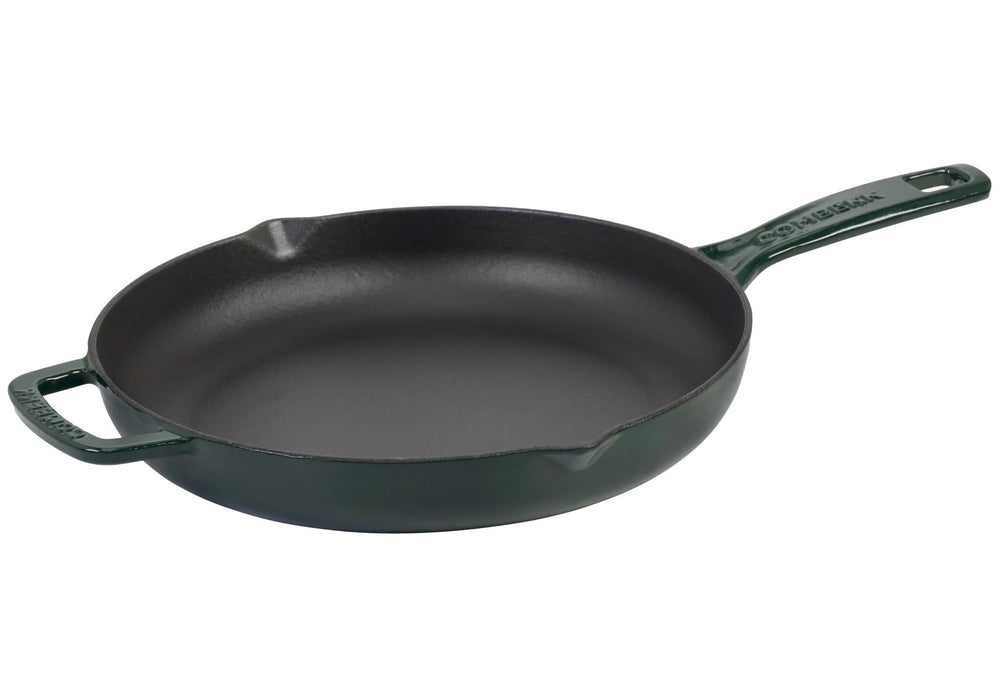
Combekk Frying Pan Skillet Classic Cast Iron Holly Green ø 26 cm
An untreated pan becomes a bad purchase if you do not know that it needs to dry on the fire after each wash. Within a week, it will rust, which means sanding and re-seasoning. If you prefer convenience, or have never seasoned a pan, then enamel or a ceramic layer is more straightforward. A middle ground is the Beka Frying Pan Stark ø 24 cm: bare cast iron that you do not need to season yourself, but drying after washing is still necessary.
Those who have already discarded a few pans with a worn layer are left with only the seasoned layer on bare cast iron. You restore that yourself if it gets damaged. The steps to build that layer up, so your food sticks less, can be found in the piece about how to season a cast iron pan.
What can cast iron not withstand?
In a bare cast iron pan, it is better not to make acidic dishes like tomato sauce: acid breaks down the seasoned layer, after which you need to re-season. With the enamelled Keij Kamado Frying Pan Skillet Blue ø 25.5 cm, that works fine, as enamel can withstand acid.
Cast iron also does poorly against these three things:
The dishwasher: bare cast iron comes out without its seasoned layer and begins to rust. You should also wash the Mandala by hand, as its ceramic layer wears out faster, and its wooden handle cannot withstand it well.
Hurry: starting quickly and adjusting quickly does not suit cast iron, as heating goes gradually, and you only notice a lower flame after a while in the pan. What stainless steel does differently in that regard can be seen in the article where we compare cast iron and stainless steel side by side.
A fall: on a hard floor, cast iron can break, and then its long lifespan is over.
If any of these points clash with how you cook, choose a pan made of another material from all frying pans.
How heavy is a cast iron frying pan?
From 0.6 to about 2.5 kg, depending on the size and type. Size makes a big difference: the Blackwell Skillet weighs 0.8 kg in ø 16 cm, 1.1 kg in ø 20, and 2 kg in ø 25. The type also matters: in ø 24 cm, the Mandala weighs 1 kg and the Stark 1.67 kg. In ø 28 cm, the difference is about a kilo: the Beka Frying Pan Mandala Cast Iron ø 28 cm weighs 1.4 kg, while the Stark weighs over 2.
For those who pay attention to weight, the Mandala in each of its sizes is the lightest cast iron pan here, although its ceramic layer wears out just like any other. Two smaller pans are also lighter: a Blackwell of ø 16 and one of ø 20 cm weigh each at most just over half of that of ø 25. If you are looking for a grill pan or wok in cast iron alongside two frying pans, check out the cast iron pan sets. How large your pan should be for your household is explained in a separate guide about what size frying pan you need.
The Blackwell of ø 25 cm and the Keij have one handle and both weigh 2 kg. The Stark is even heavier in ø 28 and ø 30 cm but has a helper handle. Such a handle distributes the weight over two hands, making it safer to move a heavy pan. If you prefer to lift your pan with one hand, stick to a smaller size.
Can you use cast iron on induction, in the oven, and on the barbecue?
You can use it for all three, but what is allowed varies by pan:
On induction: every pan you can order here works on it. Self-seasoning works best over gas, so without a gas burner, it is easier to choose a pan that is already seasoned or has a layer.
In the oven: according to their product pages, the Blackwell pans, the Stark, and the Keij are allowed in, with the Keij up to 260 °C. The Mandala is not allowed: its wooden handle cannot withstand the heat of an oven.
On the barbecue: there, a cast iron frying pan is often called a skillet, and the enamelled Keij Kamado can go directly on it, according to its product page. Other cast iron for outdoor cooking can be found among the cast iron pans for the barbecue.
If you want to simmer on low heat with a lid on, then a casserole is made for that: check out the cast iron casseroles.


