Here you mainly choose between stainless steel, sheet steel, and cast iron, and our advice starts with maintenance. You do that maintenance after each use, and a pan without a coating can last you for years.
Which metal without a coating requires the least work, and which is the heaviest?
The characteristics of the pans here provide this picture per metal.
Stainless steel does not need to be seasoned by you, and it is dishwasher safe. The symbol for that is present with every stainless steel pan here. An empty 28 cm stainless steel pan weighs between 1.2 and 1.6 kg. Pre-treated cast iron also does not need to be seasoned by you, but you wash it by hand, and it weighs 2.3 kg in 28 cm.
Sheet steel and untreated cast iron do need to be seasoned by you before the first use. Both are washed by hand, and then you dry them on the fire. An empty 28 cm sheet steel pan weighs 1.3 kg with 2 mm steel and 2.2 to 2.35 kg with 3 mm. Untreated cast iron weighs 2 kg in 25 cm, the largest size here.
With stainless steel, nothing changes about your dishwashing: the pan can go into the dishwasher after cooking, just like your plates. A stainless steel pan must be thoroughly hot before food goes in, and that heating takes a while, as the fire should not be high. Thick steel and cast iron weigh over a kilo more than stainless steel in 28 cm. Those who lift the pan often will notice that difference first.
What do you notice when cooking without a coating?
The most common mistake with a pan without a coating is, according to our pan expert, too high a heat with too little fat. You notice the most that you are cooking without a coating with these dishes:
Steak: if it is still stuck in stainless steel or sheet steel when you want to turn it, then the crust is not ready. Wait a moment and try again.
Eggs and fish: protein-rich foods are the most difficult to cook without a coating. Of the bare pans, well-seasoned sheet steel is the best choice for a fried egg, although that steel does not become as smooth as a coated one.
Tomato sauce and other acidic foods: in sheet steel and cast iron, the acid affects the seasoned layer on which you cook. Stainless steel lacks that layer, so it does not play a role there.
What if you only have induction and no gas burner to season?
For a kitchen with only induction, there are two types that you do not need to season yourself: stainless steel and pre-treated cast iron. For cast iron, it concerns the Stark pans from Beka, such as the Beka Frying Pan with Helper Handle Stark ø 28 cm.

Beka Frying Pan with Helper Handle Stark ø 28 cm
The Stark is also available in 24 and 30 cm, and together with other cast iron, it is listed among the cast iron frying pans. For sheet steel, there is also a way to season it in the oven, making a gas burner unnecessary.
Who is better off sticking with a pan with a coating?
"With a non-stick coating, it is simply easier, and we all want convenience," says our pan expert. Those who still need to learn to cook find it easier to do so with a coated pan. If you enjoy frying eggs as much as steak, you often benefit most from having two pans, one of which has a coating. For the pan with a coating, you choose between standard and ceramic, among the frying pans with non-stick coating.
Which pan without a coating do we recommend?
As little maintenance as possible after cooking: for that wish, stainless steel fits, such as the Beka Frying Pan Cicla Stainless Steel ø 24 cm. It has a cool handle, so during cooking, you can grab the handle without a kitchen towel.

Beka Frying Pan Cicla Stainless Steel ø 24 cm
A crust on your steak, and seasoning the pan yourself: for that wish, sheet steel fits, such as the Blackwell Frying Pan Carbon Steel ø 28 cm. Its product description guides you step by step through the seasoning process.
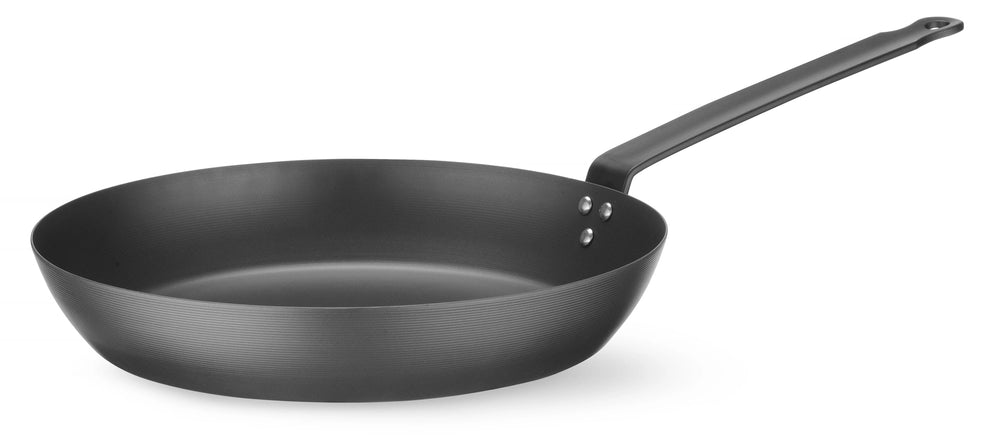
Blackwell Frying Pan Carbon Steel ø 28 cm
With stainless steel, there is still the choice between a thick bottom and layers up to the wall, and our advice on that is available with the stainless steel frying pans. We have sheet steel in 2 and 3 mm thick, and on the page with steel frying pans, you choose which thickness suits you.
Is a pan without a coating also affordable?
Those who want to spend little will mainly find sheet steel and cast iron here, as the stainless steel pans under €50 are all 20 cm. For stainless steel from 24 cm and thick steel from 24 to 28 cm, expect to pay between €50 and €100. If you prefer to spend a little more than seasoning it yourself, then choose stainless steel or pre-treated cast iron.


