4.8 Trusted Shops 22.167 reviews
Free Shipping from 149,-
1,000,000+ satisfied customers preceded you
Celebrating our 10th anniversary this year
Free Shipping from 149,-
4.8 Trusted Shops 22.167 reviews
Free Shipping from 149,-

Everything You Need to Know About Multi‑Ply Stainless Steel Frying Pans

Everything You Need to Know About Multi‑Ply Stainless Steel Frying Pans
Why multi‑ply pans? The introduction of multi‑ply pans in the kitchen has transformed the way we cook. By combining different metals, such as stainless steel, aluminum and copper, these pans offer the best of both worlds: the excellent heat conduction and distribution of aluminum or copper, with the durability and easy maintenance of stainless steel.
What kinds of stainless steel layers are there?

What kinds of stainless steel layers are there?

For us, the best stainless steel frying pan comes from one Beka line, in two constructions. For meat with a brown crust that is the Maestro RVS ø 28 cm, with its thick base. If you often cook a full pan, the more expensive Maestro 5‑Ply ø 28 cm with five layers comes into view. Both require that you can cook without a coating, and that makes them not pans for a beginner or for someone who mainly seeks convenience.

How is a multi‑ply stainless steel frying pan constructed?

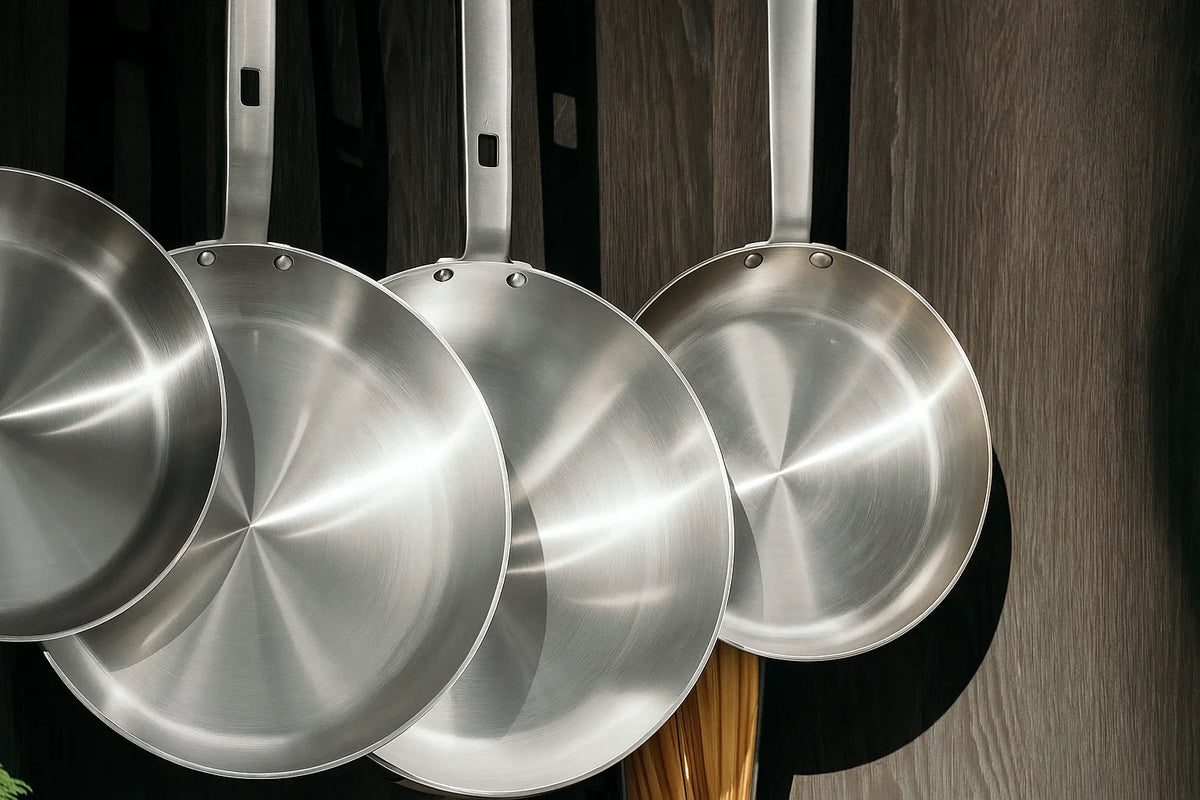
If you saw a multi‑ply stainless steel frying pan in half, you'd see layers of metal on top of each other, and how far those layers run differs per pan:

  • A thick base: the metal layers are in the base — the Beka Maestro RVS has three, and the Beka Cicla also has such a base.
  • Three layers into the wall: with the Sola Green Cooking+ Triply RVS the base and wall are made in one piece and in three layers.
  • Five layers around an aluminum core: that is how the Beka Maestro 5‑Ply is constructed, and in the 28 cm pan the heat therefore also runs up the walls.

In both Maestros the core is aluminum, a metal that distributes heat quickly and evenly. The stainless steel around it is what you cook on, and it can take a knock.

What difference do five layers make compared to a thick base?

What difference do five layers make compared to a thick base?

A steak or chicken breast lies on the bottom of the pan, and that bottom has layers in both Maestros. For that meat five layers therefore add little.

It’s different when your pan is filled to the rim, for example with vegetables or mushrooms. Food against the wall then cooks better if the wall also gets warm. That is the case with the Maestro 5‑Ply 28 cm and with the three‑layer Sola.

Of the two 28 cm Maestros the five‑layer one costs more. If you usually cook a single piece of meat, you rarely use its wall; if your pan is often full, you’ll get something out of it every time.

Who is a stainless steel frying pan not for, or not yet for?

Who is a stainless steel frying pan not for, or not yet for?

More layers don’t make stainless steel an easy pan: even in the Maestro 5‑Ply the meat only goes in once the pan is properly hot. For those who aren’t comfortable with that, or not yet, our pan expert has different advice:

  • A first frying pan: for that he recommends a pan with a non‑stick coating, and which one that is can be found in our advice on the best frying pan.
  • Especially eggs, fish and pancakes: for those you should look among the frying pans with a ceramic non‑stick coating.
  • Stainless steel, but less chance of sticking: for that there are the hybrid HexaCook pans, a line from Cookinglife itself, with stainless steel in the base and a ceramic layer on top. Because of that layer you’ll eventually need to replace this pan as well.
What do top lists and the Consumentenbond say about the best stainless steel frying pan?

What do top lists and the Consumentenbond say about the best stainless steel frying pan?

Several top lists put a seven‑layer stainless steel pan at the top. We don’t carry such a pan: with us the Maestro 5‑Ply has the most layers. A seven‑layer pan is, according to our pan expert, a conscious choice for life. For a steak or a full pan of vegetables you don’t need it in our view: a thick base and five layers already do that job.

The frying pan test from the Consumentenbond is about 28 cm pans with a PFAS‑free non‑stick coating. So that test does not give a result for a stainless steel pan without a coating. If you look up that test because of PFAS, you’ll find bare stainless steel in first place in our advice on the best frying pan without PFAS.

Which stainless steel frying pan should you choose, and why that one and not another?

Which stainless steel frying pan should you choose, and why that one and not another?

Our recommendations are all stainless steel without a coating. We’ll start with meat, because stainless steel is particularly suitable for that.

One pan for meat with a brown crust

You’re switching from a worn non‑stick pan and want one stainless steel pan in which meat gets a brown crust. The pan we recommend for that is the Beka Koekenpan Maestro RVS ø 28 cm, with a handle that stays cool and an empty weight of 1.38 kg. That crust comes from the heat of the stainless steel, and for meat that lies on the bottom the Maestro RVS’s thick base is sufficient. The 5‑Ply from the same line is more expensive, and it mainly adds something if your pan is full.

The Beka Koekenpan Cicla RVS ø 28 cm also has a multi‑layer base and is more affordable.

A pan that is often filled to the rim

A stir‑fry with vegetables and strips of chicken will quickly fill your pan to the rim. For such a dish we recommend the Beka Koekenpan Maestro 5‑Ply ø 28 cm, a five‑layer pan that weighs 1.6 kg empty. Compared with the Maestro RVS it has a wall that warms along and a helper handle. If you finish a dish in the oven, its handle and helper handle can also go in, up to about 200 °C.

A full pan in a lower price range

The Sola Koekenpan Green Cooking+ Triply RVS ø 28 cm also has a wall that heats up, because in this pan the layers run through both the base and the wall. It is more affordable than the Maestro 5‑Ply, with three layers instead of five.

A stainless steel pan alongside your coated pan

If you already have a good coated pan, adding a stainless steel pan is mainly for meat. The Beka Koekenpan Cicla RVS ø 24 cm fits that role, and costs less than the two Maestros. It is made from recycled stainless steel and weighs 0.94 kg empty.

Related howto's